Why does “Amen” matter?

Why all the uproar over a prayer at Congress?  To open the 117th Congress, practicing Methodist Preacher and Missouri Rep. Emanuel Cleaver ended his prayer with “amen and a-women.”  The Twitter world was set ablaze with proper criticism, anger, and bewilderment.  Honestly, my first thought was, “The stupidity of the liberals never ceases to amaze me.”  For a couple of days, I’ve been watching the reaction of people on social media. Honestly, Heidi and I have been amused at some of the memes of “amen and a-woman.” However, is our reaction to this offensive prayer doing any good?  What if God has given us this as an opportunity to teach people why Christians were so offended.

The word “amen” is a Semitic word meaning “truth.”  It means “to be true, let it be granted, or confirmed.” It is the Hebrew word, אָמֵ֔ן, a-men.  It is derived from the Hebrew root ‘mn meaning “to prove to be firm.”  “Amen” can be used in a few ways.  First, “Amen” is used as a solemn formula to confirm a covenant or oath.  In Deuteronomy 27:15-26, you can see the people affirming the law with a commitment of “Amen” or let it be.

In Isaiah 65:16, you see another way the Hebrew word is used.  In this passage, the Hebrew word is used twice as a noun to describe God.  Twice God is called the “God of truth.”  He is the “God of the ‘amen.’” Finally, in the Old Testament, you will find “Amen” as a response to prayer or used in ancient Israel’s corporate worship.  In Psalm 89:52, you read, “Blessed be the Lord forever, Amen and Amen.”  In other words, “Blessed be the Lord forever, let it be, or it is so.  The word is an agreement to the truth of the prayer or statement. The “Amen” acknowledges the validity of a word spoken. It’s as if we are saying, “I agree,” or “this is true.” 

In the New Testament, the Greek word is a transliteration of the Hebrew word, “Amen.”  Again, the word is used in various ways.  For instance, in Revelation 3:14, it is used as a title for Jesus Christ.  Also, in the New Testament, Paul will often use “amen” after a doxology (see Romans 1:25; 9:5; 11:36; 15:33, 16:27; Philippians 4:20, Ephesians 3:21; 1 Timothy 1:17 and 6:16 as examples).  Again, at the end of a doxology, we are acknowledging the validity of the word spoken.  As a Christian, it is a way we affirm the basis of our praise, adoration, and belief in God. 

One of the interesting ways it is used in the New Testament is by Jesus.  There are times in the Gospels Jesus is driving a point home to His listeners, and he will use the phrase, “Verily, verily.”  In modern translations, He says, “Truly.”  For instance, in John 3:3, He says, “Truly, I tell you, unless someone is born again, he cannot see the kingdom of God.”  The word “Truly” is the word “Amen.”  In other words, Jesus is saying, “Amen, I tell you …”  In Greek, He uses the word “amen” twice as, “Amen Amen, I tell you…”  That is why the King James Version uses the phrase “Verily, verily.”  The words chosen by Jesus gives His statement authority.  It is analogous to the Old Testament messenger formula of “Thus says the Lord.” 

Why do we care so much?  Why are Christians offended by Cleaver’s use of “amen and a-woman.”  For the Christians, “amen” is a word of worship and praise.  When we utter the phrase at the end of a prayer, we acknowledge our dependence and reliance upon God.  We affirm His provisional care in our lives and are praising the character and nature of God and Jesus Christ.  In faith, we say “amen” believing God can do all that is needed for us.  It is important to note, “amen” has absolutely no gender connotation to it at all.  It is a word of faith and praise to our God.

By the way, Cleaver’s closing words were not the only offensive words. His last sentence was, “We ask it in the name of the monotheistic god, Brahma, and god known by many names by many different faiths.”  It is my prayer you understand why his entire sentence is so offensive. We pray to the one true God, and Yahweh is His name. Amen and amen. If someone asks you why the uproar, try telling them how important the word “amen’ is to us. God may be using this as a teaching moment.
Pastor’s Book Club 2021

Pastor’s Book Club 2021

This time each year, I begin to create a reading list for myself.  My yearly goal is to read 52 books in a year.  I sure wish I was a faster reader. Being able to read a few more words per minute would have helped me achieve this goal. While I have my own list of potential books in 2021 (I’ll share that list later), I wanted to offer you my first five books on my Pastor’s Book Club list for 2021.

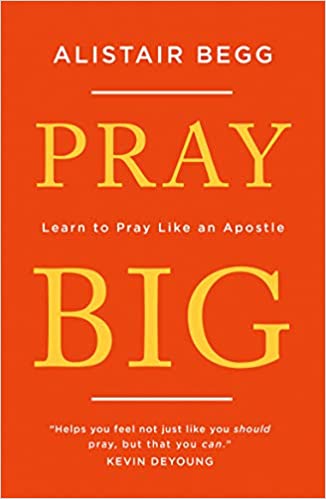
I’ll let you in on one thing. I’ve already read January’s book. It is wonderful. Heidi and I read it this fall, and we both found it beautiful.  I think you will be exceptionally blessed. I chose Begg’s book on prayer because I love the prayers in Ephesians.  For six years, I’ve been encouraging the church to pray audacious prayers.  Like the time we prayed to pay off $180,000 in debt in one year. That was a bold prayer, but God answered.

I’ve seen Reading While Black on multiple “Best Of 2020” booklists. I know this is an area I need to become better informed. I’ve chosen a few books this year to help me in this process.  In May, we will read Voddie Bauchman’s newest book, called Fault Lines.  Bauchman is a strong voice in the African American community and within the entire church community. This book will be published in April of 2021. You can preorder on Amazon.

One of my favorite authors is Russell Moore.  Moore is the President of the Ethics & Religious Liberty Commission, the Southern Baptist Convention’s public policy arm.  I have a great deal of respect for Russell Moore, and I have always been blessed through his writings.

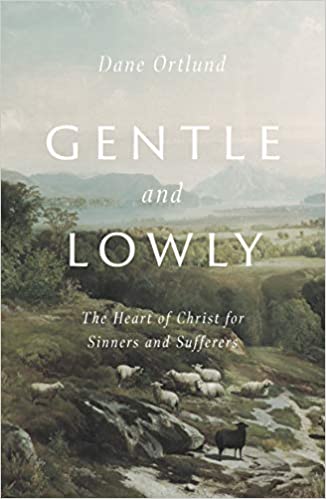
Take a look at the list below.  I will plan to meet during the Sunday School hour on the first Sunday of the following month. For instance, on February 7, we will meet at 9:00 am to discuss Gentle and Lowly.  You will be able to join via Zoom if needed. 

Feel free to join me. I’ll be planning the rest of the year later.  I want to include a strong theology title, a biography, and maybe a history book too. I’ve heard The American Story by David M. Rubenstein is very good. I hope to find a good Christian fiction book for our children and youth to read with me this summer.  If you have any ideas, please let me know.

Get that first book ordered.  Join me reading the book and come discuss it if you are able. If you have other ideas for books, please let me know. Before January 1, I’ll post the book titles I’m hoping to read. I’ll also post something that may help you read a little more this year. I’m excited to continue to grow in my grace and knowledge in 2021.

January Gentle and Lowly: The Heart of Christ for Sinners and Sufferers by Dane Ortlund

Christians know what Jesus Christ has done―but who is he? What is his deepest heart for his people, weary and faltering on their journey toward heaven? Jesus said he is “gentle and lowly in heart.” This book reflects on these words, opening up a neglected yet central truth about who he is for sinners and sufferers today.*

FebruaryPray Big: Learn to Pray Like an Apostle by Alistair Begg

This book focuses on Paul’s prayer for his friends in the church in Ephesus, that he recounts to them in Ephesians 1 v 15-23 and 3 v 14-21. The truths that underpin and shape his prayers for them will motivate us to pray and set us an example.

So be inspired by the Apostle Paul to pray bigger and pray better as we look to our heavenly Father to do more than all we ask or imagine!*

March – Reading While Black: African American Biblical Interpretation as an Exercise in Hope by Esau McCauuley

Growing up in the American South, Esau McCaulley knew firsthand the ongoing struggle between despair and hope that marks the lives of some in the African American context. A key element in the fight for hope, he discovered, has long been the practice of Bible reading and interpretation that comes out of traditional Black churches. This ecclesial tradition is often disregarded or viewed with suspicion by much of the wider church and academy, but it has something vital to say. Reading While Black is a personal and scholarly testament to the power and hope of Black biblical interpretation. At a time in which some within the African American community are questioning the place of the Christian faith in the struggle for justice, New Testament scholar McCaulley argues that reading Scripture from the perspective of Black church tradition is invaluable for connecting with a rich faith history and addressing the urgent issues of our times. He advocates for a model of interpretation that involves an ongoing conversation between the collective Black experience and the Bible, in which the particular questions coming out of Black communities are given pride of place and the Bible is given space to respond by affirming, challenging, and, at times, reshaping Black concerns. McCaulley demonstrates this model with studies on how Scripture speaks to topics often overlooked by white interpreters, such as ethnicity, political protest, policing, and slavery. Ultimately McCaulley calls the church to a dynamic theological engagement with Scripture, in which Christians of diverse backgrounds dialogue with their own social location as well as the cultures of others. Reading While Black moves the conversation forward.*

April The Courage to Stand: Facing Your Fear without Losing Your Soul by Russell Moore

In The Courage to Stand, bestselling and award-winning author Russell Moore calls readers to a Christ-empowered courage by pointing the way to real freedom from fear—the way of the cross. That way means integrity through brokenness, community through loneliness, power through weakness, and a future through irrelevance.

On the other side of fear is freedom: the freedom to stand.*

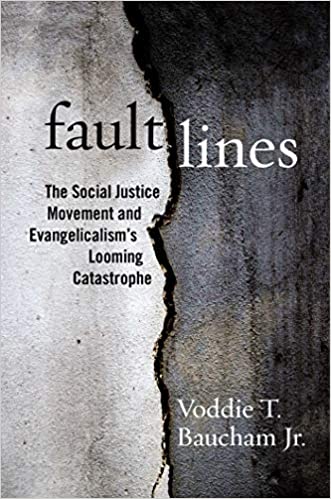
May: Fault Lines: The Social Justice Movement and Evangelicalism’s Looming Catastrophe by Voddie Bauchman.

We are standing on shaky ground.

            As a wave of violent riots protesting the death of a black man at the hands of police shook the nation in the summer of 2020, most Americans were shocked. Christians nationwide, eager to fulfill their God-given calling to bring peace and reconciliation, took to pulpits and social media in droves to affirm that “black lives matter” and proclaim that racial justice “is a gospel issue.”

            But what if those Christians, those ministers, and those powerful ministries don’t know the whole story behind the new movement that’s been making waves in their congregations? Even worse: what if they’ve been duped into adopting a set of ideas that not only don’t align with the Kingdom of God, but stand diametrically opposed to it?

            In this powerful book, pastor, professor, and leading cultural apologist Voddie Baucham explains the sinister worldview behind the social justice movement and how it has quietly spread like a fault system, not only through our culture, but throughout the evangelical church in America. He also details the devastation it is already wreaking—and what we can do to get back on solid ground before it’s too late.

            Whether you’re a layperson who feels like you’ve just woken up in a strange new world and wonder how to engage both sensitively and effectively in the conversation on race, or a pastor who’s wondering how to deal with increasingly polarized factions within your congregation, this book will provide the clarity and understanding you need to either hold your ground, or reclaim it.*

*(This write-up has been copied from Amazon.)

Please take a moment and let me know what you’ll be reading in 2021. I’m always looking for good titles.